


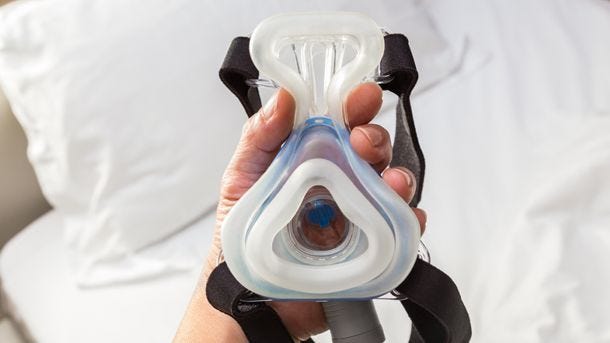
"I Can't Breathe!" How to Fix CPAP Suffocation Feelings
Key Takeaways
-
If you struggle to exhale, ensure your Expiratory Pressure Relief (EPR) or Flex setting is enabled and set to its maximum (Level 3) to reduce resistance.
-
If you feel you aren't getting enough air at the start of the night, increase your Ramp Starting Pressure from 4 cm H2O to 6 or 7 cm H2O for a more satisfying initial flow.
-
Switch to a nasal pillow or "under-the-nose" mask to reduce the claustrophobic footprint that often triggers the "suffocating" sensation.
Sometimes we get calls from CPAP patients using full face CPAP masks calling in asking what to do about the feeling that they can't breathe with CPAP mask.
Like aircraft pilots, CPAP patients can get the sensation of not being able to breathe. This sensation could be caused by several different factors. The following is a short list of causes and their remedies.
1. Positive Pressure is Too High - Check with your physician and insurance provider about getting a Respironics DreamStation or a Resmed AirSense10 Auto CPAP machine with many comfort breathing features.
2. Arrested Breathing - This can happen to many people. There have been many movies that have shown military pilots that take their masks off. The movie Independence Day has an example. To solve the problem, hold your breathe and count to five slowly, then begin breathing normally again.
3. Claustrophobic - Imagine yourself in a boat in the middle of a calm lake fishing with your best friend. Hold your breathe and count to five slowly, then begin breathing normally again. If this doesn't help get a CPAP nasal mask or nasal pillow masks.
Chris Vasta is the president of The CPAP Shop and an expert in sleep and respiratory therapy. He often provides insights on product design and functionality on various manufacturers’ prototypes and is frequently tapped to provide reviews on new releases.
This post was updated with the latest information in January 2026.
It is the #1 reason people quit sleep apnea therapy: that panicky, "air-hungry" feeling that makes you want to rip the mask off your face at 2 AM. Whether you feel like you aren't getting enough air or you feel like you’re fighting a "wall of air" when you try to exhale, the sensation is real—but it is almost always a settings issue, not a failure of the machine.
In 2026, modern CPAP technology has introduced smarter ways to mimic natural breathing. If you feel like you can't breathe, one of these four "comfort levers" is likely the culprit.
1. Try Expiratory Pressure Relief
The most common complaint is the difficulty of breathing out against the continuous incoming pressure. This can lead to a feeling of breathlessness or chest muscle soreness.
The 2026 Solution: Expiratory Pressure Relief (EPR). Almost all modern machines (like the ResMed AirSense 11) feature EPR or "Flex" technology.
-
How it works: The machine detects the exact millisecond you begin to exhale and drops the pressure by 1, 2, or 3 cm H2O. This makes it feel like you are breathing normally rather than fighting a leaf blower.
-
Pro Tip: If you feel like you're fighting the machine, check your "Comfort" settings and ensure EPR is set to Level 3.
2. Your Starting Pressure May Be Too Low
Paradoxically, many people feel they "can't breathe" because the pressure is too low. If your machine starts at the default of 4 cm H2O, you may feel like you’re breathing through a thin straw. This is called "Air Hunger."
The 2026 Solution: Adjusting Your Ramp Start. The "Ramp" feature is designed to start at a low pressure and gradually increase. However, if 4 cm H2O feels suffocating, you can adjust your "Ramp Start Pressure" to 6 or 7 cm H2O. This provides a more robust flow of air immediately, satisfying your lungs' demand for volume while you're still awake.
3. If You Feel Claustrophobic, Try a Different Style Mask
If the sensation of suffocation is more "panic-based" than "pressure-based," your mask footprint is likely too large.
-
The Old Way: Standard full-face masks that cover the bridge of the nose and the mouth can feel like a "cage."
-
The 2026 Way: Minimal-Contact Masks. Masks like the AirFit F30i or nasal pillow systems (which sit under the nose) leave your field of vision open and keep your face clear. Reducing the "surface area" of the mask often instantly eliminates the psychological feeling of suffocation.
The CPAP Shop has partnered with MaskFit AR to offer hassle-free, personalized shopping recommendations that will help you find the perfect CPAP mask to fit your needs. Simply answer some questions, scan your face, and we’ll help you find the right mask for you. Watch this video to learn how MaskFit AR works!
4. Try Adjusting Your Humidity Settings
If your nose is congested, CPAP will feel impossible. When your nasal passages are swollen, the pressurized air creates "turbulence" instead of flow, which triggers the brain's suffocation alarm.
-
Check Your Humidifier: In 2026, "Auto Climate Control" is standard. If the air feels too dry or too "heavy," adjust your heated tubing to a higher temperature to keep the air thin and easy to inhale.
- Replace Your Humidifier: Notice a performance change in your humidity during therapy? Or has it been a while since last replacing it? Purchase a replacement humidifier every 6 months to ensure optimal performace.
Conclusion
For more tips and tricks to comfortable CPAP therapy, contact our helpful staff at 866-414-9700. We'd be happy to help you get the most successful treatment.


