


The Minimalist Revolution: Why Nasal Pillow CPAP Masks are the Go-To for Comfort
Key Takeaways
-
Nasal pillow masks offer the least facial contact, making them ideal for users with claustrophobia or skin sensitivity, while providing a completely open field of vision.
-
Modern nasal pillow masks feature top-of-head hose routing, allowing 360-degree rotation and preventing the hose from snagging while sleeping on your side.
-
They are most effective and comfortable for patients with mild or moderate sleep apnea who do not habitually breathe through their mouth.
The New Go-To CPAP Mask – Nasal Pillows
The days of big, bulky, and heavy masks are over. Not only has the size and weight for nasal and full face CPAP masks had numerous design improvements, but the comfort factor also continues to advance. More CPAP users are realizing that they are not stuck with the old, uncomfortable and ill fitting mask their DME gave them. Choices abound and it’s highly likely that if your CPAP is not working for you, another one exists which will do the job.
Is the CPAP Nasal Pillow Mask Taking Over?
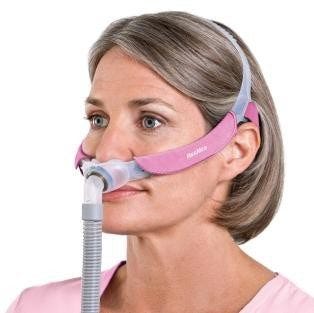
Even with comfort and choices for nasal and full face CPAP masks increasing, nasal pillow masks and hybrid masks are becoming all the rage. It’s quite obvious why a nasal pillow or hybrid mask is popular; extremely lightweight, few parts, limited facial contact, no eyesight impairment and remarkably comfortable. Thus, who would not want to wear a mask which was barely noticeable while wearing? For the most part, people who are able to use them are quite satisfied with them and most likely would not return to a nasal or full face CPAP mask unless it was necessary.
A Little History About CPAP Nasal Pillow Masks
Nasal pillow mask started to become popular around the time Puritan Bennett released their Breeze Sleepgear and ResMed released the original Swift. The Puritan Bennett Breeze and ResMed Swift were highly innovative and essentially broke ground on a new style of masks. Both are still relatively popular today. However, looking at today’s nasal pillow masks, the Breeze and Swift are clunky and outdated. However, always the innovator, ResMed’s Swift FX is the most popular nasal pillow mask on the market today. Its lightweight design and comfort has made a convert out of many nasal mask users. Of course, ResMed is not the only manufacturer to have successful nasal pillow masks.
Phillips Respironics OptiLife with its square pillow design has had modest success. Two 2nd tier manufacturers, Devilbiss and Fisher &Paykel, each have launched very successful entrants into the market. Devilbiss’ Aloha nasal CPAP mask has a creative headgear and nasal pillow assembly which is both comfortable and effective. Fisher &Paykel’s Pilairo CPAP mask has a single band headgear, only three parts, and is extremely lightweight. Although both are not as well known, each has had moderate success with its nasal pillow masks.
CPAP Hybrid Masks vs. CPAP Nasal Pillow Masks
Hybrid masks are the new entrants onto the mask stage. A hybrid mask lies somewhere in between a nasal pillow mask and a nasal mask. It has a very small profile with the cushion just large enough to cover the nose. The Fisher & Paykel Eson was the initial hybrid and received a bit of traction. It’s essentially a very small profile nasal mask which includes a forehead piece for support. The cushion is made to just cover the nose. The Phillips Respironics Wisp CPAP Mask is the newest and most popular on the market. It’s a true hybrid with the looks of a nasal pillow mask but a very small nasal cushion. Without a forehead bar, it relies on an innovative headgear that secures the mask in place. Its compact design and open field of vision is certainly attractive for those who would like to use a nasal pillow mask but prefer a standard nasal mask. From the first few days after the release, Phillips Respironics seems to have hit the mark. It has received very good reviews and continues to fly off the shelves. Of course, time will tell but all indications are CPAP users like its fit and feel.
New – More Comfortable - Solutions for CPAP Masks
As mentioned, CPAP masks continue to evolve. With CPAP use on the rise, it’s imperative that manufacturers such as ResMed, Phillips Respironics, Devilbiss and Fisher & Paykel continue to improve upon the comfort and style of masks. Remember that an old, uncomfortable CPAP mask is not the only solution. With all the options available, try something new. A comfortable and effective CPAP mask not only increases compliance but enables CPAP users to increase the quality of their sleep.
The CPAP Shop strives to enhance the lives of people with sleep apnea through information and high-quality therapeutic products. If you have questions about CPAP masks or machines or any of our line of accessories, please call (866) 414-9700.

This post was updated with the latest information in December 2025.
The world of CPAP masks has definitively moved away from bulky, cumbersome designs toward comfort, mobility, and open fields of vision. At the forefront of this shift is the Nasal Pillow CPAP Mask.
Originally considered a niche alternative to traditional nasal masks, nasal pillows have cemented their status as a preferred choice for millions of users seeking the most minimalist and comfortable therapy experience available. Their evolution showcases a commitment to making CPAP therapy barely noticeable, significantly boosting compliance and quality of life.
Here’s why nasal pillow masks have become the "new go-to" option for so many CPAP users.
The Core Advantages of Nasal Pillow Design
Nasal pillow masks, such as the Resmed AirFit P10, replace a traditional cushioned cup with two soft silicone prongs that sit directly at the entrance of the nostrils. This design offers three game-changing advantages:
Minimal Facial Contact
This design is the ultimate choice for reducing the feeling of confinement. With virtually no mask material touching the bridge of the nose, cheeks, or forehead, nasal pillows dramatically reduce:
-
Claustrophobia: Users who feel anxious or closed-in by larger masks often find instant relief with a minimalist pillow design.
-
Skin Irritation: Less mask means fewer contact points, which greatly reduces pressure marks, rashes, and acne flare-ups common with larger cushions.
Unrestricted Field of Vision
Because the only contact points are beneath the nose, the mask leaves the entire field of vision open. This allows users to read, wear glasses, watch TV, or use their phone right up until they fall asleep, promoting a more natural pre-sleep routine.
Lightweight and Travel-Friendly
Nasal pillow masks are typically made of fewer parts and lighter materials than any other mask type. This makes them incredibly easy to clean, pack, and carry, cementing their popularity among travelers who use portable CPAP devices.
Technological Advancements: Freedom for Side Sleepers
While the original nasal pillow masks were revolutionary, modern designs have incorporated key innovations that make them even more versatile, particularly for active and side sleepers.
Top-of-Head Hose Routing
One of the most significant modern innovations is the top-of-head hose connection. Masks like the Resmed AirFit P30i route the air tube up and over the head, allowing the user to connect the CPAP hose at the crown of their head via a rotating elbow.
-
Enhanced Mobility: This allows for a full 360-degree rotation.
-
Side-Sleeper Solution: The hose is kept out of the way, making it virtually impossible to snag or dislodge the mask's seal while sleeping on your side or stomach.
Suitable for Lower Pressures
Nasal pillow masks provide focused air delivery directly to the nostrils. This makes them highly effective for patients with Mild to Moderate Sleep Apnea or those on lower pressure settings (typically below 12 cmH2O). However, they are generally not recommended for chronic mouth breathers or patients requiring very high-pressure settings, as this can sometimes lead to nasal irritation or air leaking through an open mouth.
The Hybrid Evolution
While not true nasal pillows, Hybrid Masks represent a bridge between the nasal pillow and the full face mask.
Hybrid designs, such as the Philips Respironics DreamWear family (which uses a flexible frame to deliver air), borrow the open field of vision and minimalist aesthetic of the nasal pillow while incorporating different cushion styles (like an under-the-nose cushion) to accommodate different pressure needs without covering the whole face. This blend of form and function further reinforces the industry’s drive toward lighter, less intrusive therapy options.
If you value freedom of movement, a clear line of sight, and minimal contact, a nasal pillow mask is likely the most comfortable and compliant choice for your CPAP journey.


