
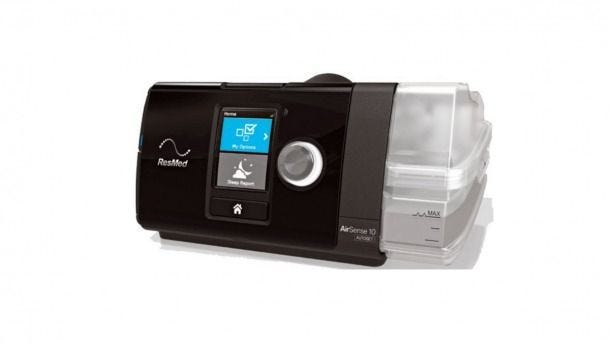
Respironics Dreamstation Vs ResMed AirSense 10 Auto CPAP Machine
Key Takeaways
-
The AirSense 10 is favored for its long-term mechanical reliability and "gold standard" pressure algorithm, while the DreamStation 2 offers a more modern touchscreen and smartphone integration.
-
The DreamStation 2 is significantly more compact, making it a better hybrid option for users who want one machine for both home use and frequent travel.
-
The AirSense 10 "Card-to-Cloud" models rely on physical SD cards for data, whereas the DreamStation 2 uses Bluetooth to sync with the DreamMapper app for instant feedback.
Sometimes it helps to see two CPAP machines compared side by side. In this video Chris Vasta, CEO of the CPAP Shop aligns the Philips Respironics DreamStation compared to the AirSense10 Autoset CPAP by ResMed.
To Compare Dreamstation vs AirSense, let's start with design. 10 Both machines have swivel connections for heated tubing, and both machines have heated humidifiers. Both machines accept power input from both AC and DC sources.
When both machines are next to each other, it is readily apparent that the DreamStation is a little bit longer (3.3 inches tall and 11.7 inches long). The AirSense10 (5.91 inches tall and 10.5 inches long) is a little bit taller if you attach their humidifiers.
Chris demonstrates how easy it is to remove the water chamber on the AirSense10, to open it and clean it. Similarly, he shows how the DreamStation water chamber is easy to open and clean. And, it also has a button that, when pressed, completely disengages the water chamber and heated humidifier, so that the machine can operate without it. Once removed, the DreamStation is very small, even smaller than the AirSense10 without its water chamber. Both machines have easy access to filters for replacement.
Both machines are automatic with the power button located on the top. They both have a dial that the user can turn and push to scroll through user menus on a color screen. Both machines are automatic so they both record and report on compliance data. Data such as AHI, leak rate, average usage, and events per hour are all reported. They each also have pre-installed easily accessible SD cards.
The AirSense10 uses a programming app called MyAir to provide support therapy. It sends information from the CPAP machine to a computer or smart phone. The DreamStation has a mobile app called DreamMapper to provide therapy feedback and track progress.
Some additional comparisons between the two machines include:
Warranty: both machines come with a standard 2 Year Warranty.
Sound Level: AirSense10 is marginally louder at 26 dBa compared to the DreamStation at 25.8 dBa.
CPAP Size: AirSense10 is slightly bigger at 4.6 x 10.0 X 5.91 compared to the DreamStation at 7.6 x 6.2 x 3.3.
CPAP with Humidifier: The AirSense10 remains the same size but the added humidifier on the DreamStation makes it almost the same size: 11.7 x 7.6 x 3.3. The AirSense10 only operates with a humidifier while the DreamStation can operate as just a CPAP without a humidifier, presumably while traveling.
Features: Both machines can operate as an Auto or Fixed CPAP. They also have a pressure range of 4-20 cm H2O, offer exhale pressure relief, and ramp features to make it easier to fall asleep. Both machines can be operated from battery power and work on a voltage of 100 - 240 VAC. They both have automatic altitude adjustment for pressure settings, compensate for mask leaks, and have optional heated tubing. The AirSense10 machine uses ultra fine filters, while the DreamStation uses both ultra fine and pollen filters.
Reviews: Our clients have awarded the AirSense10 a 4.5 star (out of 5) review. The DreamStation has a comparable 4.2 rating.
You can find a lot more information about The DreamStation Auto CPAP machine and the AirSense10 Autoset CPAP machine on our website. TheCPAPShop.com's knowledgeable staff will be happy to answer any questions via phone or chat.

This post was updated with the latest information in December 2025.
For over a decade, the "ResMed vs. Philips" rivalry has defined the CPAP industry. However, the landscape has changed dramatically. As we move through 2025, the debate isn't just about features; it’s about reliability, safety, and modern connectivity.
With the original DreamStation now a part of sleep therapy history due to the 2021–2024 recall, the new head-to-head matchup is between the legendary ResMed AirSense 10 AutoSet and the redesigned Philips DreamStation 2.
The Resmed AirSense 10: The "Reliable Workhorse"
While the AirSense 11 is ResMed’s flagship, the AirSense 10 remains one of the best-selling machines in 2025. Why? Because it works. It is the "gold standard" for reliability.
In 2025, most users are opting for the Card-to-Cloud (C2C) version of the AirSense 10. This model lacks a cellular modem (originally due to chip shortages) but offers the same elite AutoSet algorithm at a much more accessible price point.
-
Noise Level: 26.6 dBA (Whisper-quiet).
-
Best Feature: AutoSet Algorithm. It remains the most "human-like" pressure adjustment in the industry.
-
Connectivity: Uses an SD card to track data, which can be uploaded to your doctor via your PC.
The Philips DreamStation 2: The "Modern Comeback"
The DreamStation 2 is Philips’ answer to the safety concerns of the past. It features a completely redesigned silicone-based sound abatement foam and a much sleeker, more compact footprint than its predecessor.
The DreamStation 2 is built for the "smart home" era, featuring a color touchscreen and integrated Bluetooth. It is significantly smaller than the AirSense 10, making it a favorite for those who want a "home" machine that can also travel easily.
-
Noise Level: ~27.2 dBA (Slightly louder than ResMed, but still very quiet).
-
Best Feature: Touchscreen & Portability. The interface is as intuitive as a smartphone.
-
Connectivity: Bluetooth-ready for the DreamMapper app, providing daily "sleep scores."
Head-to-Head Comparison: 2025 Specs
| Feature | ResMed AirSense 10 (C2C) | Philips DreamStation 2 |
| Footprint | 4.5" x 10" x 6" | 3.3" x 7.6" x 6.2" |
| Weight | 2.75 lbs | 2.9 lbs |
| Screen Type | Dial & LCD | Color Touchscreen |
| Humidifier | Built-in (Standard) | Built-in (Heated) |
| Data Tracking | SD Card (Manual Upload) | Bluetooth (Automatic App) |
| Expiratory Relief | EPR (3 Levels) | Flex (3 Levels) |
The Verdict: Which Should You Choose?
Choose the ResMed AirSense 10 if: You want the most proven, reliable algorithm on the market and don't mind manually uploading your data via an SD card. It’s the perfect choice for users who want "set it and forget it" therapy with the quietest operation possible.
Choose the Philips DreamStation 2 if: You prioritize a modern, compact design and want to see your data on your phone immediately via Bluetooth. It’s ideal for tech-savvy users who need a smaller machine that fits comfortably on a crowded nightstand.


